Regenerative Medicine · Oakville, Ontario
PRP Therapy in Oakville
Platelet Rich Plasma injections harness your body's own healing factors to repair damaged tissue, reduce inflammation, and restore function — without surgery.
What Is PRP?
Platelet Rich Plasma Therapy in Oakville, Ontario
Platelet Rich Plasma (PRP) therapy is a regenerative injection treatment that uses a concentrated preparation of your own blood's platelets to accelerate healing. Platelets contain growth factors — including PDGF, TGF-β, and VEGF — that play a critical role in tissue repair and regeneration.
By concentrating these growth factors and injecting them directly into the site of injury, PRP stimulates your body's natural healing cascade: reducing chronic inflammation, promoting new collagen formation, and restoring damaged tissue.
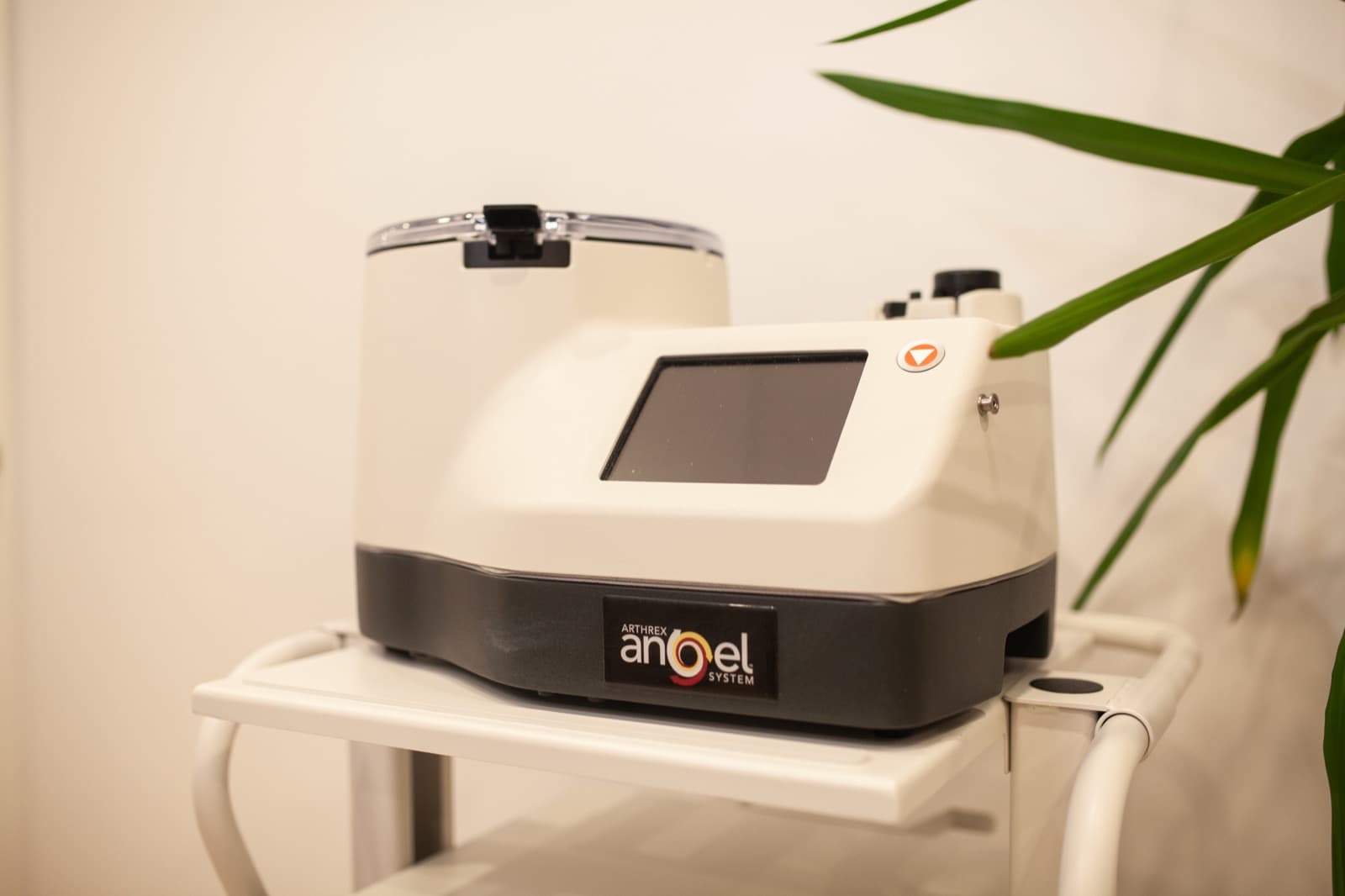
At Oakville Pain Clinic in Oakville, we use the Arthrex Angel PRP System — a state-of-the-art platform that produces highly concentrated, customizable PRP preparations for optimal therapeutic outcomes.
Conditions Treated
Who Can Benefit from PRP Therapy?
PRP is effective for a wide range of musculoskeletal conditions, from chronic joint pain to acute sports injuries.
Knee Osteoarthritis
Reduce pain and improve function without surgery
Chronic Tendon Injuries
Tennis elbow, Achilles, rotator cuff, patellar
Ligament Sprains
ACL, MCL, and ankle ligament injuries
Plantar Fasciitis
Heel and foot pain resistant to conservative care
Hip Bursitis
Trochanteric bursitis and gluteal tendinopathy
Meniscus Injuries
Partial tears and degenerative meniscal damage
Sports Injuries
Muscle tears, overuse injuries, and joint sprains
Degenerative Disc Disease
Spinal disc degeneration and facet arthropathy
Evidence-Based Applications
PRP for Common Conditions in Oakville
PRP therapy is most effective for chronic tendon, ligament and joint conditions where conservative care has plateaued. Below are the conditions we treat most often at Oakville Pain Clinic, with a note on what the clinical evidence currently supports.
PRP for Hip Pain & Trochanteric Bursitis
Pain on the side of your hip — often called trochanteric bursitis or gluteal tendinopathy — is a common stubborn injury that doesn’t always get better with usual care. PRP injected under ultrasound into the affected hip tendons can help heal the tissue and ease the pain. We also treat hip osteoarthritis with PRP placed inside the joint.
PRP for Wrist & Hand Conditions
PRP can help long-standing wrist pain from cartilage damage (TFCC injury), wrist ligament strains, thumb base arthritis, and chronic wrist tendon problems. The wrist has a lot of small structures packed close to nerves and blood vessels, so we always use ultrasound to guide the needle — we never inject blindly in this area.
PRP for Sports Injuries & Ligament Sprains
Athletes and active people often choose PRP to get back to their sport faster after lingering muscle or tendon injuries, repeated ligament sprains (MCL, ankle), or knee scope recovery. PRP doesn’t replace your physiotherapy and training — but it can speed up healing when an overuse injury has stalled.
Looking for a more potent regenerative option? Ask your physician about MCT autologous exosome therapy — a Health Canada-approved photo-thermal treatment that substantially increases the exosome and growth-factor yield from your own platelets.
Self-Refer for a PRP ConsultationThe Process
How PRP Therapy Works
The entire procedure takes approximately 60 minutes, from blood draw to injection.
Consultation
Your physician evaluates your condition, reviews imaging, and determines if PRP is the right treatment for you.
Blood Draw
A small sample of blood is drawn from your arm — no different from a routine blood test.
Centrifuge Processing
Your blood is processed in our Arthrex Angel PRP system to isolate and concentrate the platelet-rich fraction.
Precision Injection
The concentrated PRP is injected directly into the injured area, with ultrasound guidance available for maximum accuracy.
Compare Your Options
PRP vs. Other Treatments
Understand how PRP therapy compares to common alternatives for chronic joint and tendon pain.
PRP vs. Cortisone
Steroid Injections
- •Cortisone masks pain; PRP promotes actual tissue repair
- •Repeated cortisone can weaken tendons and cartilage
- •PRP benefits build over weeks and last months to years
- •Cortisone relief is temporary (weeks to months)
- •PRP uses your own blood — no synthetic drugs
PRP vs. Surgery
Knee Replacement & Arthroscopy
- •PRP is minimally invasive — no incisions or general anesthesia
- •No hospital stay or extended rehabilitation required
- •Return to normal activities within days, not months
- •Can delay or eliminate the need for surgery entirely
- •Significantly lower cost and fewer risks
PRP vs. Hyaluronic Acid
Viscosupplementation
- •PRP stimulates healing; hyaluronic acid only lubricates
- •PRP addresses the underlying tissue damage
- •Clinical studies show longer-lasting pain relief with PRP
- •PRP is effective for tendons and ligaments — not just joints
- •Single PRP session often outperforms a series of HA injections
Why Choose Us
PRP Therapy at Oakville Pain Clinic
Arthrex Angel System
We use the Arthrex Angel — a hospital-grade PRP platform that produces highly concentrated, customizable preparations with consistently superior platelet yields.
Board-Certified Physicians
Every PRP treatment is performed by a board-certified physician with specialized training in interventional pain management and regenerative medicine.
No Referral Needed
Self-refer directly through our online form. Our team contacts you within 24 hours to schedule your PRP consultation — no waiting for a GP referral.
Frequently Asked Questions
PRP Therapy Questions
What is PRP therapy and how does it work?
+
Platelet Rich Plasma (PRP) therapy is a regenerative treatment that uses concentrated platelets from your own blood. A small blood sample is drawn, processed in a centrifuge to isolate the platelet-rich fraction (containing growth factors like PDGF, TGF-β, and VEGF), and injected directly into the injured area. These growth factors stimulate tissue repair, reduce inflammation, and promote natural healing.
How much does PRP therapy cost in Oakville?
+
PRP therapy is a private-pay procedure not covered by OHIP. The cost varies depending on the treatment area and whether ultrasound guidance is used. We provide detailed pricing during your consultation and issue receipts for extended health insurance claims. Many patients find PRP cost-effective compared to surgery or long-term medication use.
Is PRP therapy painful?
+
The injection itself is similar to a standard joint or tendon injection — most patients describe it as mild to moderate discomfort, and we use local anesthetic to minimize pain. The blood draw is no different from a routine lab test. What patients should plan for is the recovery, especially if your physician recommends our highest-concentration PRP. That formulation produces the strongest healing response, but it also produces significant discomfort for up to 48 hours after the injection and typically requires about 2 weeks of bracing to keep weight off the treated area while it heals. Braces, crutches and walking boots are available for purchase at the clinic at the time of your injection, so you'll leave with what you need. After a high-concentration PRP injection, please arrange for someone to drive you home — most patients don't feel comfortable driving immediately after. Recovery is significantly easier with lower-concentration PRP, which is suitable for many tendon and joint conditions. Your physician will recommend the right concentration for you and walk you through exactly what to expect at the time of your consultation.
How many PRP sessions will I need?
+
Most patients require 1–3 PRP sessions spaced 4–6 weeks apart, depending on the condition and severity. Some patients experience significant improvement after a single treatment. During your consultation at Oakville Pain Clinic, your physician will recommend a personalized treatment plan based on your specific condition.
What is the difference between standard PRP and ultrasound-guided PRP?
+
Standard PRP involves injecting the platelet concentrate using anatomical landmarks to guide needle placement. Ultrasound-guided PRP uses real-time imaging to visualize the needle and target tissue during the injection, ensuring precise delivery. Ultrasound guidance is recommended for deep structures, small joints, areas near nerves, and patients who have had unsuccessful blind injections.
What conditions can PRP treat?
+
PRP therapy is effective for knee osteoarthritis, chronic tendon injuries (tennis elbow, Achilles tendinopathy, rotator cuff), ligament sprains, plantar fasciitis, hip bursitis, meniscus injuries, degenerative disc disease, and muscle tears. It is also used for sports injuries and to accelerate post-surgical healing.
Is PRP better than cortisone injections?
+
PRP and cortisone work differently. Cortisone is a steroid that reduces inflammation and provides rapid pain relief, but the effect is temporary (typically weeks to a few months) and repeated injections can weaken tendons and cartilage. PRP stimulates actual tissue repair by delivering concentrated growth factors to the injury site. While PRP takes longer to show results (2–6 weeks), the benefits are longer-lasting and address the underlying damage rather than just masking symptoms. Many patients choose PRP after cortisone stops providing relief.
How long does it take to see results from PRP therapy?
+
Initial improvement is typically noticed within 2–6 weeks as the growth factors stimulate tissue repair. Full results develop over 3–6 months as new tissue forms and strengthens. Many patients report continued improvement for up to a year after treatment. Results vary depending on the condition being treated and individual healing response.
Does PRP work for knee osteoarthritis?
+
Yes — knee osteoarthritis is one of the strongest evidence-based applications of PRP therapy. Multiple meta-analyses of randomized controlled trials have shown that PRP injections produce clinically significant pain reduction and functional improvement at 3, 6, and 12 months, with benefits often lasting up to 24 months from a treatment course. PRP has also been shown to outperform hyaluronic acid (viscosupplementation) for mild-to-moderate knee osteoarthritis. We treat patients across Oakville, Burlington and the GTA with knee OA who want to delay or avoid surgery.
Can PRP help tennis elbow (lateral epicondylitis)?
+
Yes. Tennis elbow is a chronic tendinopathy of the lateral epicondyle, and PRP has strong clinical evidence in chronic tendinopathies that have failed conservative care (rest, physiotherapy, bracing). PRP can also be considered for golfer's elbow (medial epicondylitis). At Oakville Pain Clinic we typically deliver PRP for elbow tendinopathies under ultrasound guidance for precise placement at the affected tendon insertion.
Is PRP effective for rotator cuff injuries?
+
PRP can help rotator cuff tendinopathy and partial-thickness tears in select patients, particularly when conservative care has failed and the patient wants to avoid surgery. The evidence is stronger for non-surgical rotator cuff tendinopathy than as an adjunct to surgical repair. Your physician will assess your specific imaging and symptoms and discuss whether PRP is a reasonable option for your shoulder.
Can PRP treat plantar fasciitis?
+
Yes. PRP is increasingly used for chronic plantar fasciitis that has not responded to several months of conservative treatment (stretching, orthotics, physiotherapy, anti-inflammatories). Studies suggest PRP outperforms cortisone for sustained heel-pain relief beyond 3 months. We deliver PRP to the plantar fascia under ultrasound guidance.
Can PRP help Achilles, patellar or other chronic tendon injuries?
+
Yes. Chronic tendinopathies — including Achilles tendinopathy, patellar tendinopathy (jumper's knee), gluteal tendinopathy and proximal hamstring tendinopathy — are among the strongest evidence-based applications of PRP. These conditions often resist conservative care because tendons have limited blood supply. Concentrated growth factors delivered directly into the affected tendon can re-initiate the repair process.
What is the recovery time after a PRP injection?
+
Recovery time depends on the concentration of PRP your physician recommends. The concentration is selected at consultation based on your condition, the severity of the injury, and how aggressive a healing response is appropriate for you. For our highest-concentration PRP (used for the most stubborn or severe injuries), expect about 2 weeks of recovery using a brace to keep weight off the treated area, with significant discomfort possible for the first 48 hours. Braces, crutches and walking boots are available for purchase at the clinic, and you should arrange a ride home rather than driving yourself. For lower-concentration PRP — suitable for many tendon and joint conditions — recovery is significantly easier: most patients return to desk work the same day, with mild soreness at the injection site for 2 to 5 days as the healing response begins. Across all PRP concentrations, we ask you to avoid anti-inflammatory medications (NSAIDs) and ice for 1 to 2 weeks after injection, since the goal of PRP is to trigger a controlled healing inflammation. Your physician will explain exactly which concentration is right for you and what to expect at the time of consultation.
Is PRP covered by extended health insurance in Ontario?
+
Many extended-health benefit plans in Ontario partially reimburse PRP under regenerative medicine, sports medicine or specialist injection benefits. Coverage varies widely by insurer and plan. We provide detailed receipts coded appropriately for insurance submission. We recommend confirming with your insurer in advance whether PRP injections are an eligible expense under your specific plan.
Do I need a referral for PRP therapy in Oakville?
+
No. Oakville Pain Clinic offers a self-referral program for PRP therapy. You can book directly through our online self-referral form or by phone at 647-910-5359, and our team will contact you within 24 hours to schedule your consultation. We also accept referrals from family doctors, sports medicine physicians, physiotherapists and chiropractors.
Ready to Start?
Book Your PRP Consultation Today
No physician referral required. Self-refer today and our team will contact you within 24 hours to schedule your PRP consultation.
PRP Therapy in Oakville — Serving the Greater Toronto Area
Oakville Pain Clinic offers advanced Platelet Rich Plasma (PRP) therapy in Oakville, Ontario. Using the Arthrex Angel PRP system, our board-certified physicians prepare highly concentrated autologous platelet preparations for treating knee osteoarthritis, tennis elbow (lateral epicondylitis), Achilles tendinopathy, patellar tendinopathy (jumper's knee), plantar fasciitis, rotator cuff tendinopathy, hip pain (trochanteric bursitis), wrist pain and chronic sports injuries. Both standard and ultrasound-guided PRP injections are available, with same-week booking through our self-referral program.
We treat patients seeking PRP therapy across the Halton Region and the Greater Toronto Area — including all Oakville neighbourhoods (Bronte, Glen Abbey, West Oak Trails, Joshua Creek, Iroquois Ridge, College Park, Old Oakville, Eastlake, Clearview), as well as Burlington, Mississauga, Milton, Hamilton, Halton Hills (Georgetown and Acton), Brampton, Etobicoke and Toronto. Our clinic is located at Unit 7, 1400 Cornwall Road in Oakville, easily accessible from the QEW, 403 and 407.
If you're searching for PRP therapy near me, platelet rich plasma injections in Oakville, regenerative medicine in Burlington, or PRP for knee osteoarthritis or tennis elbow in the Halton Region, contact Oakville Pain Clinic at 647-910-5359 or self-refer online. Want a more potent regenerative option? Learn about our Health Canada-approved autologous exosome therapy using the MCT System.