Elbow Pain Treatment · Oakville, Ontario
PRP for Tennis Elbow & Golfer's Elbow
Tennis elbow and golfer's elbow are stubborn injuries that often hang on for months despite rest, braces and physiotherapy. PRP has strong clinical evidence as a treatment when nothing else has worked — delivering your own healing growth factors right to the damaged tendon.
About the Condition
Tennis Elbow & Golfer's Elbow Treatment in Oakville, Ontario
Tennis elbow (lateral epicondylitis) is pain on the outside of your elbow, usually from chronic overuse of the tendons that extend your wrist. Golfer's elbow (medial epicondylitis) is the same problem on the inside of the elbow. Despite the names, you don't have to play tennis or golf — these conditions affect anyone who repetitively grips, types, lifts, paints, plays an instrument or works with their hands.
These are tendon problems, not joint problems. The tendon develops microscopic tears that don't heal properly because tendons have a poor blood supply. The result: a stubborn, achy pain at the elbow that gets worse with gripping or lifting, often radiating into the forearm.
Standard care — activity modification, anti-inflammatories, a brace, physiotherapy, and sometimes one cortisone injection — works for many patients within 6 to 12 months. But about 1 in 5 patients still has pain a year later. That's where PRP shines: it's specifically designed for chronic tendinopathies that haven't healed on their own.
Conditions We Treat
Tennis Elbow — Forms We Address
We tailor each PRP treatment to your specific diagnosis. Below are the most common presentations we see at Oakville Pain Clinic.
Chronic Tennis Elbow
Lateral epicondylitis lasting more than 3 months despite conservative care.
Chronic Golfer's Elbow
Medial epicondylitis with persistent inner-elbow tendon pain.
Failed Cortisone Elbow
Cortisone may have helped briefly but pain has returned or worsened.
Failed Physiotherapy
Eccentric loading and other physio protocols haven't fully resolved the pain.
Tradespeople & Manual Workers
Heavy gripping, hammering, lifting — high-load occupational tendinopathies.
Office Workers & Mouse-Arm Pain
Chronic computer-related forearm and elbow tendinopathy.
Active Athletes
Tennis, badminton, racquet sports, climbing and weightlifting.
Recurrent Tennis Elbow
Pain that keeps coming back after periods of relief.
Why PRP Works
Why PRP Has Strong Evidence for Tennis Elbow
Tennis elbow is one of the conditions where PRP has the strongest published evidence. The landmark Mishra et al. multicentre randomized controlled trial of 230 patients with chronic lateral epicondylitis showed clinically meaningful improvements in pain and function at 24 weeks compared with an active control. A subsequent systematic review and meta-analysis of placebo-controlled trials confirmed durable benefit beyond 3 months.
The mechanism makes sense: tennis elbow is fundamentally a tendon-healing problem. The tendon has tried to heal itself and failed. PRP delivers a high concentration of your own growth factors right to the damaged tendon insertion, restarting the repair process. Over weeks to months, the tendon remodels and gets stronger.
General background on PRP and elbow tendinopathy is available from the American Academy of Orthopaedic Surgeons (AAOS). We always use ultrasound guidance for elbow PRP — the wrist extensor and flexor tendons attach to a small area at the elbow, and the median and ulnar nerves run nearby, so ultrasound is essential for both safety and accuracy.
- •Strong evidence in chronic lateral epicondylitis (tennis elbow) — multiple RCTs
- •Often outperforms cortisone for sustained relief beyond 3 months
- •Targets the actual tendon damage rather than masking pain
- •Works for golfer's elbow (medial epicondylitis) on the same principle
- •Ultrasound-guided injection ensures precise targeting near nerves
- •Single injection often sufficient — sometimes a second at 6 weeks
The Process
How Your PRP Treatment Works
The full procedure is completed in a single in-clinic visit of about 60 minutes — from blood draw to injection.
Consultation
Your physician examines your elbow, confirms the diagnosis with ultrasound, and reviews your history of conservative care.
Blood Draw & PRP Prep
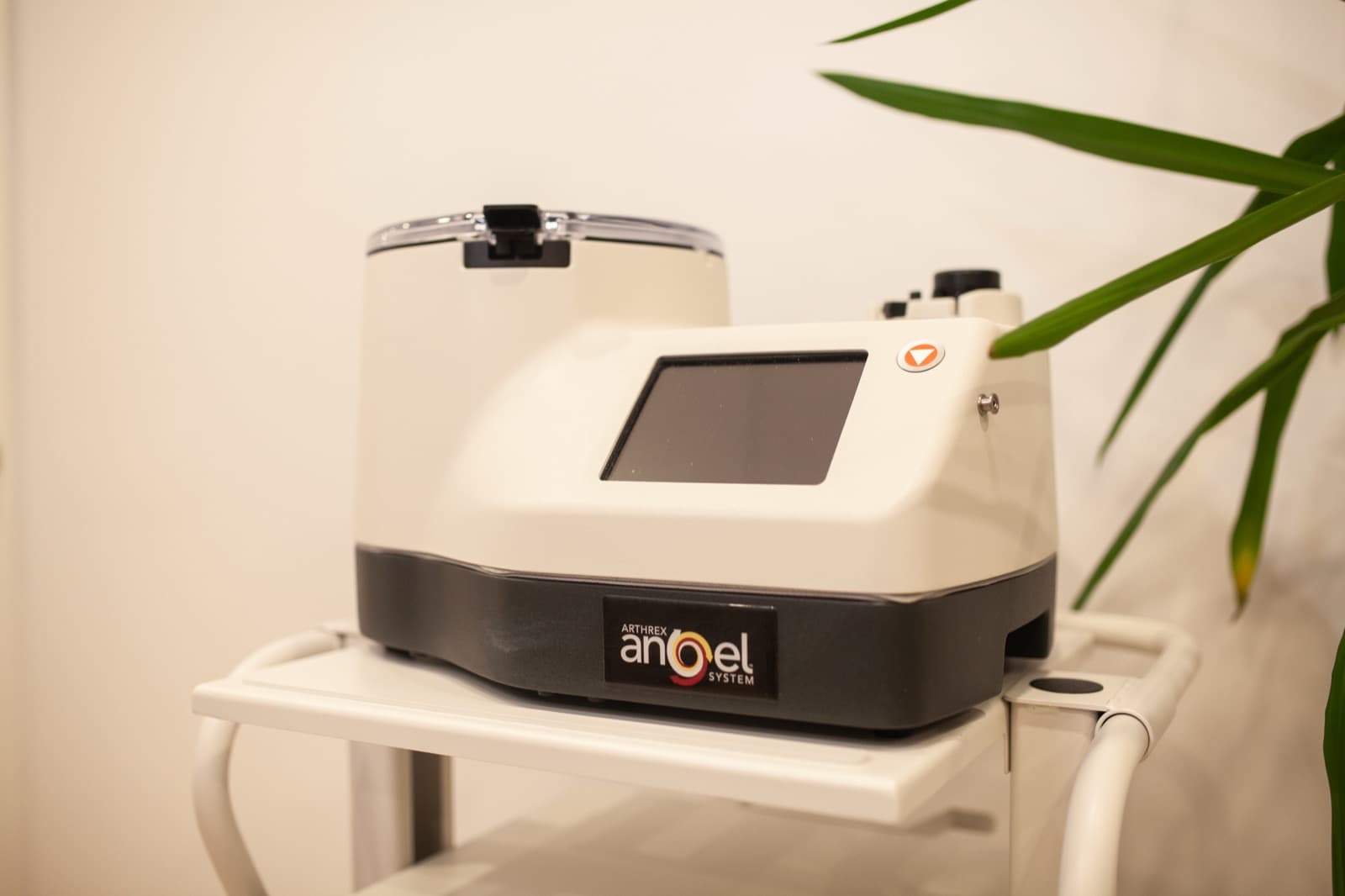
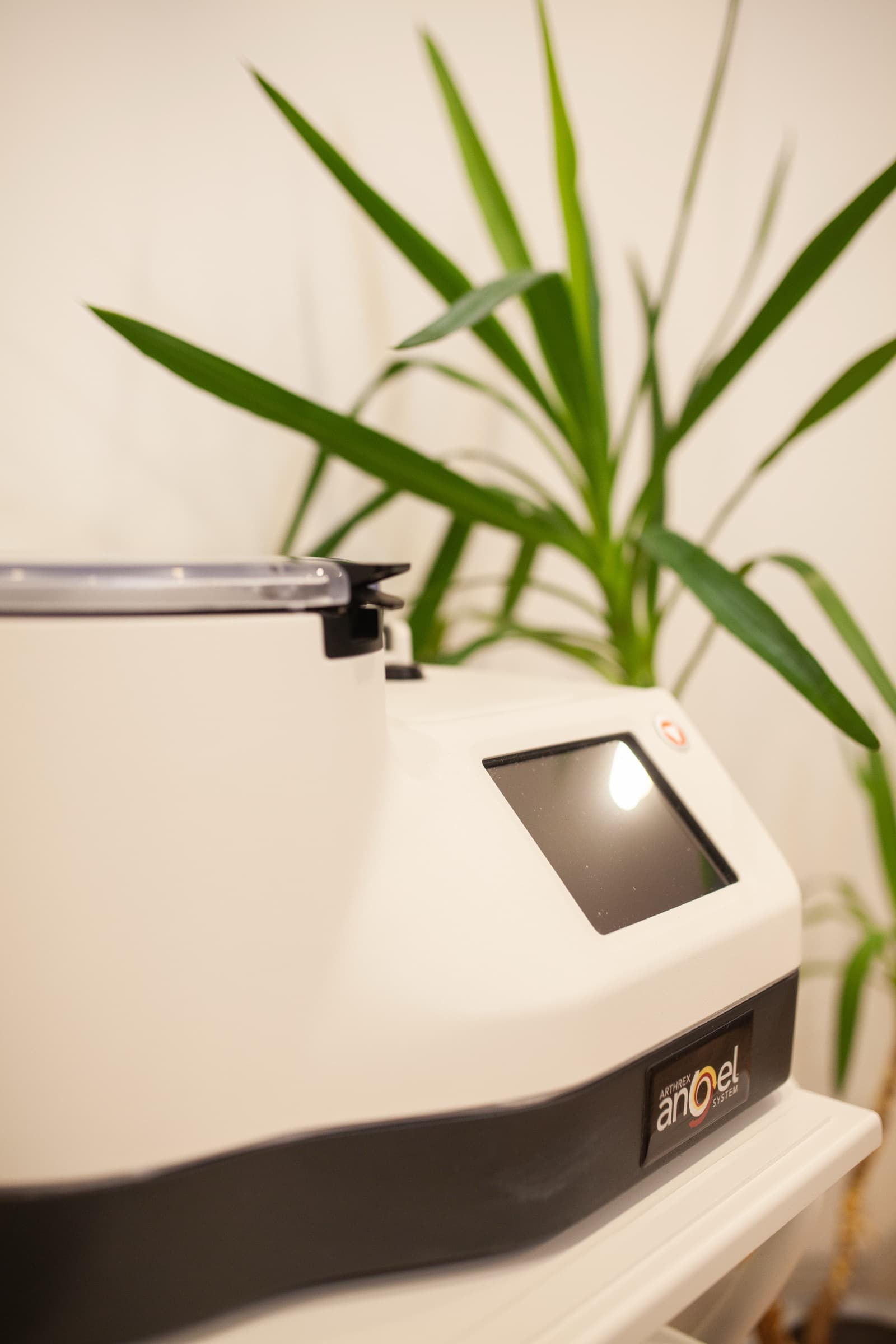
A small blood sample is drawn and processed in our Arthrex Angel system to isolate concentrated platelet rich plasma.
Ultrasound-Guided Injection
PRP is delivered precisely into the affected tendon at the elbow under live ultrasound — essential because of nearby nerves.
Recovery & Activity Modification
Brief rest from the aggravating activity, gradual return to gripping and loading. Most patients need 1 session — sometimes 2 spaced 6 weeks apart.
More Regenerative Options
PRP, Exosomes & Other Treatments
This page focuses on PRP for tennis elbow. Learn more about our full PRP therapy programme, our Health Canada-approved autologous exosome therapy (MCT System) for a more potent regenerative response, or all of our pain treatment options in Oakville.
Related Conditions
Other conditions we treat with PRP
Patients with tennis elbow often have — or develop — overlapping problems. Here are the related pages worth reading next.
PRP for Shoulder & Rotator Cuff
Upper-extremity tendinopathy rarely stays isolated. Many tennis elbow patients also have rotator cuff irritation from the same overuse pattern.
Read more →Frozen Shoulder Treatment
If your elbow problem is being aggravated by shoulder stiffness, addressing both matters.
Read more →PRP for Achilles & Patellar Tendinopathy
Same biology — chronic tendinopathy. Many active patients have multiple stubborn tendinopathies at once.
Read more →Related Reading
From the Oakville Pain Clinic blog
The 7 Most Common Pickleball Injuries — and How They Heal
Pickleball elbow IS tennis elbow. If you picked yours up on the court, this covers the broader pattern of injuries we see.
PRP vs Cortisone: Which Is Right for Your Joint or Tendon Pain?
Tennis elbow is one of the conditions where PRP most clearly outperforms cortisone. Here's the evidence.
How Long Until PRP Actually Works? A Realistic Recovery Timeline
Tendon healing is slow. Here's what to actually expect over the 6 months after your elbow PRP injection.
Frequently Asked Questions
Tennis Elbow & PRP — FAQ
Does PRP really work for tennis elbow?
+
Yes — chronic tennis elbow (lateral epicondylitis that has not responded to 3+ months of conservative care) is one of the strongest evidence-based applications of PRP. Multiple randomized clinical trials show that PRP produces sustained pain relief and improved function, often outperforming cortisone for results lasting beyond 3 months.
Will PRP help golfer's elbow too?
+
Yes. Golfer's elbow (medial epicondylitis) is the same kind of chronic tendinopathy as tennis elbow, just on the inside of the elbow rather than the outside. The same regenerative principle applies and PRP is a reasonable option when conservative care has failed.
Is PRP better than cortisone for tennis elbow?
+
Studies suggest yes — for relief that lasts beyond 3 months. Cortisone often gives quick relief at 1–2 weeks but the relief frequently fades, and repeated cortisone can actually weaken the tendon and slow healing. PRP relief takes longer to develop (4–8 weeks) but tends to last much longer because PRP is helping the tendon actually heal.
How many PRP injections do I need for tennis elbow?
+
Most patients respond to a single injection. Some patients with severe or long-standing tendinopathy benefit from a second injection at the 6-week mark. Your physician will assess your progress and recommend whether a follow-up session is needed.
How long until I notice improvement?
+
Tennis elbow PRP typically takes 4 to 8 weeks for noticeable improvement, with continued benefit building over 3 to 6 months as the tendon remodels. Tendon healing is slow — but the relief, when it comes, is usually durable. In the first 1–2 weeks after PRP, soreness at the injection site is normal and is part of the healing response.
What's the recovery like for tennis elbow PRP?
+
The injection feels similar to a standard tendon injection — most patients describe mild to moderate discomfort with local anesthetic to minimize pain. After the injection: avoid heavy gripping, lifting and the aggravating activity for 1–2 weeks. Avoid NSAIDs and ice for 1–2 weeks since they would blunt the healing inflammatory response. Most patients return to desk work the same day. With our highest-concentration PRP, expect more significant soreness for the first 48 hours.
Will I need a brace after PRP?
+
Most tennis-elbow PRP patients don't need a brace, but a counterforce brace can be helpful for the first 1–2 weeks if you have a job that requires gripping. Braces are available for purchase at the clinic if needed.
Should I keep doing physiotherapy after PRP?
+
Yes. The combination of PRP + structured physiotherapy (especially eccentric loading exercises) tends to produce the best results. We typically recommend a brief reduction in physio intensity for the first 1–2 weeks post-injection, then a return to your physiotherapist's program. We're happy to coordinate directly with your physio.
How much does PRP for tennis elbow cost in Oakville?
+
PRP is a private-pay procedure not covered by OHIP. Cost varies based on the concentration selected. Many extended-health benefit plans cover a portion under regenerative medicine, sports medicine or specialist injection benefits. We provide detailed receipts for insurance.
Ready to Start?
Book a Tennis Elbow Consultation
No physician referral required. Self-refer today and our team contacts you within 24 hours to schedule your consultation.
Sources & References
The clinical evidence cited above is drawn from the following peer-reviewed studies and authoritative medical sources:
- 1.Mishra AK, et al. Efficacy of Platelet-Rich Plasma for Chronic Tennis Elbow: A Double-Blind, Prospective, Multicenter, Randomized Controlled Trial of 230 Patients. American Journal of Sports Medicine, 2014.
- 2.Clinical efficacy of platelet-rich plasma in the treatment of lateral epicondylitis: a systematic review and meta-analysis of randomized placebo-controlled clinical trials. Clinical Rheumatology, 2020.
- 3.Effectiveness of Platelet-Rich Plasma for Lateral Epicondylitis: A Systematic Review and Meta-analysis Based on Achievement of Minimal Clinically Important Difference. Orthopaedic Journal of Sports Medicine, 2022.
- 4.American Academy of Orthopaedic Surgeons (AAOS) — Platelet-Rich Plasma (PRP). OrthoInfo.
The information on this page is for general educational purposes only and is not a substitute for personalized medical advice. Consult one of our physicians to discuss whether PRP therapy is right for your specific condition.
PRP for Tennis Elbow & Golfer's Elbow in Oakville — Serving the Halton Region & GTA
Oakville Pain Clinic offers ultrasound-guided platelet rich plasma (PRP) injections for chronic tennis elbow (lateral epicondylitis) and golfer's elbow (medial epicondylitis). Our board-certified physicians treat tradespeople, athletes, racquet-sport players, climbers, weightlifters and office workers whose elbow tendinopathy hasn't responded to physiotherapy, bracing or cortisone.
We treat elbow pain patients from across Oakville (Bronte, Glen Abbey, West Oak Trails, Joshua Creek, Iroquois Ridge, College Park, Old Oakville, Eastlake, Clearview), as well as Burlington, Mississauga, Milton, Hamilton, Halton Hills (Georgetown and Acton), Brampton, Etobicoke and Toronto. Our clinic is at Unit 7, 1400 Cornwall Road in Oakville, easily accessible from the QEW, 403 and 407.
If you're searching for PRP for tennis elbow Oakville, golfer's elbow treatment, lateral epicondylitis injection, or chronic elbow pain treatment in the Halton Region, contact Oakville Pain Clinic at 647-910-5359 or self-refer online — our team will reach out within 24 hours.