Heel Pain Treatment · Oakville, Ontario
PRP for Plantar Fasciitis & Heel Pain
If your plantar fasciitis hasn't gotten better after months of stretching, orthotics and physiotherapy, PRP is worth considering. Studies show PRP gives longer-lasting heel pain relief than cortisone — and unlike cortisone, it helps the tissue actually heal.
About the Condition
Plantar Fasciitis & Heel Pain Treatment in Oakville, Ontario
Plantar fasciitis is one of the most common causes of heel pain in adults. The plantar fascia is a thick band of tissue that runs along the bottom of your foot, from the heel bone to the toes. When it becomes irritated and degenerative, it causes that classic stabbing pain at the heel — worst on your first steps in the morning or after sitting for a while.
Standard treatment — stretching, supportive shoes, custom orthotics, anti-inflammatories, ice, physiotherapy, and sometimes one cortisone injection — works for about 80% of patients within 6 to 12 months. But a meaningful group of patients still has heel pain a year later. For those patients, the next step is often regenerative treatment rather than surgery.
PRP is well-suited to chronic plantar fasciitis because the underlying problem is degeneration of the fascial tissue, and PRP delivers your own healing growth factors directly to the site of damage. The injection is delivered under ultrasound guidance to ensure precise placement at the most affected part of the fascia.
Conditions We Treat
Plantar Fasciitis — Forms We Address
We tailor each PRP treatment to your specific diagnosis. Below are the most common presentations we see at Oakville Pain Clinic.
Chronic Plantar Fasciitis
Heel pain lasting more than 6 months despite conservative care.
Failed Cortisone Heel
Cortisone may have helped briefly but the pain returned, or stopped lasting.
Bilateral Heel Pain
Plantar fasciitis in both feet — we can treat one or both per visit.
Runners' Heel Pain
Active runners with persistent fasciitis affecting training and racing.
Standing-Job Heel Pain
Teachers, nurses, retail and trades workers on their feet all day.
Heel Spur Pain
Heel spurs are usually a finding alongside plantar fasciitis. Treating the fascia is key.
Pre-Surgical Patients
Patients considering plantar fascia release surgery who want to try regeneration first.
Recurrent Plantar Fasciitis
Heel pain that returns after each season or activity load increase.
Why PRP Works
Why PRP Works for Plantar Fasciitis
Plantar fasciitis is fundamentally a tissue degeneration problem — the fascia has tried to heal repeatedly and failed. PRP delivers a high concentration of your own growth factors directly into the damaged fascia, restarting the repair process.
A 2025 systematic review and meta-analysis of 24 randomized controlled trials (1,653 participants) found that PRP yielded significantly better visual analog scale (pain) scores than cortisone at 3 and 6 months, with better functional scores at 6 and 12 months. An earlier systematic review of randomized controlled trials in OJSM reached a similar conclusion: for chronic plantar fasciitis, PRP provides more durable pain relief than cortisone.
Cortisone gives quick anti-inflammatory pain relief at 1–2 weeks but the effect frequently fades, and repeated cortisone in the heel carries risks of fat-pad atrophy and even fascial rupture. PRP relief takes longer to develop (4–8 weeks) but tends to last because PRP is helping the fascia actually heal. General background on PRP is available from the American Academy of Orthopaedic Surgeons (AAOS). All of our heel PRP injections are delivered under live ultrasound guidance to ensure precise placement at the most affected portion of the fascia.
- •Strong evidence for chronic plantar fasciitis that hasn't responded to conservative care
- •Longer-lasting pain relief than cortisone in published studies
- •Avoids the heel fat-pad atrophy and fascial-rupture risks of repeated cortisone
- •Targets the actual fascial damage rather than masking inflammation
- •Ultrasound-guided injection ensures precise placement
- •Can be combined with continued stretching, orthotics and physiotherapy for best results
The Process
How Your PRP Treatment Works
The full procedure is completed in a single in-clinic visit of about 60 minutes — from blood draw to injection.
Consultation
Your physician examines your foot, confirms plantar fasciitis with ultrasound, and reviews your history of conservative care.
Blood Draw & PRP Prep
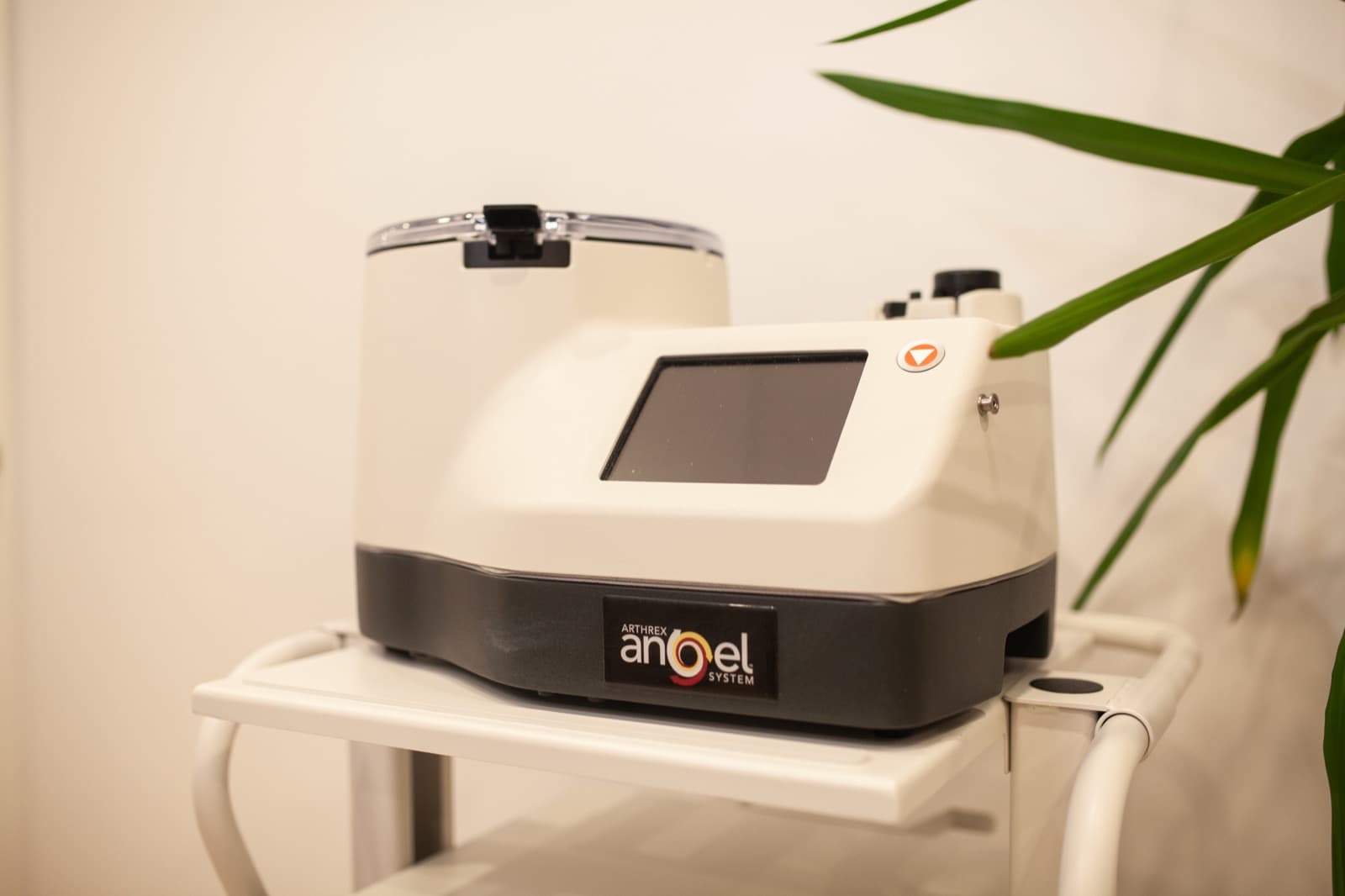
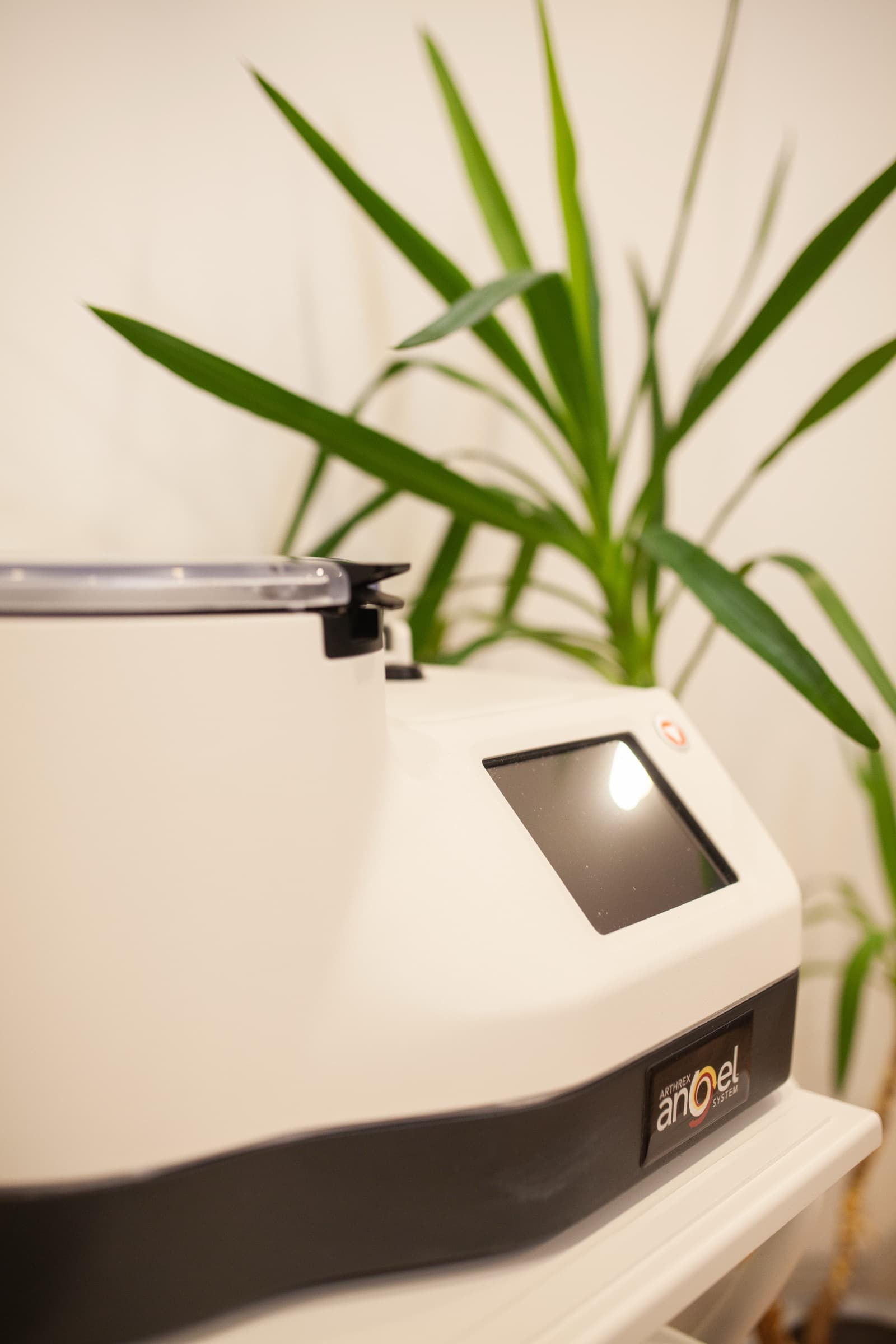
A small blood sample is drawn and processed in our Arthrex Angel system to isolate concentrated platelet rich plasma.
Ultrasound-Guided Injection
PRP is delivered precisely into the most affected portion of the plantar fascia under live ultrasound — essential for accuracy and safety.
Recovery & Activity Modification
Limited weight-bearing for the first 48 hours, then gradual return to walking and standing. Most patients need 1 PRP session — sometimes a second at 6 weeks.
More Regenerative Options
PRP, Exosomes & Other Treatments
This page focuses on PRP for plantar fasciitis. Learn more about our full PRP therapy programme, our Health Canada-approved autologous exosome therapy (MCT System) for a more potent regenerative response, or all of our pain treatment options in Oakville.
Related Conditions
Other conditions we treat with PRP
Patients with plantar fasciitis often have — or develop — overlapping problems. Here are the related pages worth reading next.
PRP for Achilles & Patellar Tendinopathy
Foot and ankle tendon problems often coexist. Plantar fasciitis and Achilles tendinopathy share the same overload patterns.
Read more →PRP for Knee Osteoarthritis
Lower-limb biomechanical dysfunction is rarely isolated to the foot — knee osteoarthritis often coexists with chronic plantar fasciitis.
Read more →PRP for Tennis Elbow & Golfer's Elbow
Same chronic-tendinopathy biology, different body part. Same regenerative principle applies.
Read more →Related Reading
From the Oakville Pain Clinic blog
The 7 Most Common Pickleball Injuries — and How They Heal
If your heel pain started after picking up pickleball, you're not alone. Common-injuries breakdown including plantar issues.
PRP vs Cortisone: Which Is Right for Your Joint or Tendon Pain?
Cortisone for heel pain has real risks (fat-pad atrophy, fascial rupture). Here's why PRP often wins.
How Long Until PRP Actually Works? A Realistic Recovery Timeline
Fascial healing takes time. Here's a realistic week-by-week look at heel PRP recovery.
Frequently Asked Questions
Plantar Fasciitis & PRP — FAQ
Does PRP work for plantar fasciitis?
+
Yes — PRP has good clinical evidence for chronic plantar fasciitis that hasn't responded to several months of conservative care (stretching, orthotics, anti-inflammatories, physiotherapy). Studies show PRP gives longer-lasting heel pain relief than cortisone, and PRP helps the fascia actually heal rather than just temporarily masking inflammation.
Is PRP better than cortisone for plantar fasciitis?
+
For most patients with chronic plantar fasciitis, yes — PRP gives more durable relief. Cortisone gives quick anti-inflammatory pain relief but the effect frequently fades, and repeated cortisone in the heel carries risks of fat-pad atrophy (which causes its own kind of heel pain) and even rupture of the plantar fascia. Many patients turn to PRP after one or two cortisone shots have stopped helping.
How long does it take for PRP to work for heel pain?
+
Most patients notice improvement within 4 to 8 weeks as the fascia heals, with continued benefit building over 3 to 6 months. Tendon and fascial healing is slow — patience matters with PRP. In the first 1–2 weeks soreness at the injection site is normal and is part of the healing response.
How many PRP sessions do I need for plantar fasciitis?
+
Most patients respond to a single injection. Some patients with severe or long-standing fasciitis benefit from a second injection at the 6-week mark. Your physician will assess your progress and recommend whether a follow-up is needed.
What's the recovery like after a heel PRP injection?
+
The injection feels like a typical heel injection — there's a brief sharp pain that local anesthetic minimizes, but the heel can be tender for 24 to 72 hours. We recommend limiting weight-bearing for the first 48 hours: short distances, supportive shoes, no running or long walks. After about 2 weeks you can typically return to most activities. With our highest-concentration PRP, expect more significant soreness for the first 48 hours and possibly a walking boot — boots are available for purchase at the clinic.
Can I keep wearing orthotics and stretching after PRP?
+
Yes — please do. PRP works best alongside continued conservative care. Keep wearing your orthotics, doing your calf and plantar fascia stretches, and following your physiotherapist's program. The PRP supports the tissue's ability to heal; the supportive measures protect that healing.
What about heel spurs — does PRP help those?
+
Heel spurs are bone outgrowths that often appear alongside plantar fasciitis but are usually not the actual source of pain — the inflamed and damaged plantar fascia is. Treating the fascia with PRP typically resolves the pain even though the bone spur itself doesn't change. We don't recommend specifically targeting bone spurs with PRP.
Will I avoid plantar fascia surgery if I do PRP?
+
For many patients, yes. Plantar fascia release surgery is a last resort with mixed long-term outcomes — many surgeons now recommend PRP and other regenerative options before surgical release. PRP can be a meaningful step that lets you avoid surgery entirely.
How much does PRP for plantar fasciitis cost in Oakville?
+
PRP is a private-pay procedure not covered by OHIP. Cost varies based on the concentration selected. Many extended-health benefit plans cover a portion under regenerative medicine or specialist injection benefits. We provide detailed receipts for insurance.
Ready to Start?
Book a Plantar Fasciitis Consultation
No physician referral required. Self-refer today and our team contacts you within 24 hours to schedule your consultation.
Sources & References
The clinical evidence cited above is drawn from the following peer-reviewed studies and authoritative medical sources:
- 1.Comparison of PRP Injections Versus Corticosteroid Injections in Plantar Fasciitis: Systematic Review and Meta-analysis. PubMed, 2025.
- 2.Hurley ET, et al. Platelet-Rich Plasma Versus Corticosteroids for Plantar Fasciitis: A Systematic Review of Randomized Controlled Trials. Orthopaedic Journal of Sports Medicine, 2020.
- 3.Hohmann E, Tetsworth K, Glatt V. Platelet-Rich Plasma Versus Corticosteroids for the Treatment of Plantar Fasciitis: A Systematic Review and Meta-analysis. American Journal of Sports Medicine, 2021.
- 4.American Academy of Orthopaedic Surgeons (AAOS) — Platelet-Rich Plasma (PRP). OrthoInfo.
The information on this page is for general educational purposes only and is not a substitute for personalized medical advice. Consult one of our physicians to discuss whether PRP therapy is right for your specific condition.
PRP for Plantar Fasciitis in Oakville — Serving the Halton Region & GTA
Oakville Pain Clinic offers ultrasound-guided platelet rich plasma (PRP) injections for chronic plantar fasciitis and heel pain. Our board-certified physicians treat patients whose heel pain hasn't responded to several months of stretching, orthotics, anti-inflammatories, physiotherapy or cortisone — including runners, retail and standing-job workers, teachers, nurses and active patients across the GTA.
We treat plantar fasciitis patients from across Oakville (Bronte, Glen Abbey, West Oak Trails, Joshua Creek, Iroquois Ridge, College Park, Old Oakville, Eastlake, Clearview), as well as Burlington, Mississauga, Milton, Hamilton, Halton Hills (Georgetown and Acton), Brampton, Etobicoke and Toronto. Our clinic is at Unit 7, 1400 Cornwall Road in Oakville, easily accessible from the QEW, 403 and 407.
If you're searching for plantar fasciitis treatment Oakville, heel pain treatment near me, PRP for chronic heel pain, or non-surgical heel injections in the Halton Region, contact Oakville Pain Clinic at 647-910-5359 or self-refer online — our team will reach out within 24 hours.