Shoulder Pain Treatment · Oakville, Ontario
PRP for Shoulder Pain & Rotator Cuff
Chronic shoulder pain that hasn't responded to physiotherapy doesn't always need surgery. Ultrasound-guided PRP injections can help heal damaged rotator cuff tendons and reduce shoulder pain — using your own blood's healing factors.
About the Condition
Shoulder Pain & Rotator Cuff Treatment in Oakville, Ontario
The rotator cuff is the group of four small muscles and tendons that wrap around the shoulder joint and hold your arm in place. Because the shoulder is the most mobile joint in the body, the rotator cuff is under constant load — and it's one of the most common sources of chronic shoulder pain in adults over 40.
Common shoulder problems include rotator cuff tendinopathy (tendon irritation and degeneration), partial-thickness rotator cuff tears, shoulder impingement (where the rotator cuff catches against the bone above it), bursitis, and biceps tendon pain. These often start gradually, get worse with overhead activities, and can interrupt sleep when lying on the affected side.
Conventional care — rest, physiotherapy, anti-inflammatories, cortisone shots — works for many patients but leaves a meaningful group with stubborn pain. For those patients who want to avoid or delay surgery, PRP is a regenerative alternative that can help the tendon actually heal rather than just temporarily masking the pain.
Conditions We Treat
Shoulder Pain — Forms We Address
We tailor each PRP treatment to your specific diagnosis. Below are the most common presentations we see at Oakville Pain Clinic.
Rotator Cuff Tendinopathy
Chronic tendon irritation without a frank tear. The most common shoulder PRP indication.
Partial Rotator Cuff Tears
Small tears that haven't progressed enough to require surgical repair.
Shoulder Impingement
Pinching of the rotator cuff under the acromion bone with overhead movement.
Subacromial Bursitis
Inflammation of the bursa above the rotator cuff causing pain on movement.
Biceps Tendinopathy
Pain at the front of the shoulder from chronic biceps tendon irritation.
Calcific Tendinitis
Calcium deposits within rotator cuff tendons causing acute or chronic pain.
Frozen Shoulder Adjunct
PRP can be used alongside physiotherapy for stiff, painful shoulders.
Failed Cortisone Shoulder
Patients whose cortisone injections have stopped working or stopped lasting.
Why PRP Works
Why PRP Helps Shoulder & Rotator Cuff Pain
Tendons heal slowly because they have a limited blood supply — that's why a rotator cuff problem can hang around for months even with rest and physiotherapy. PRP works by delivering a concentrated dose of your own healing growth factors directly to the damaged tendon, jump-starting the repair process.
Clinical evidence is strongest for rotator cuff tendinopathy and partial-thickness tears in patients who haven't had surgery. A systematic review and meta-analysis published in PLOS One found that PRP significantly reduced pain and improved shoulder function compared with placebo and corticosteroids. A more recent 2024 meta-analysis in KSSTA described PRP as offering modest but durable functional benefit over cortisone for non-surgical rotator cuff tendinopathy.
The evidence is more mixed for PRP as a surgical adjunct (combined with rotator cuff repair surgery), so we'll give you an honest assessment based on your specific MRI or ultrasound findings. General background on PRP and shoulder care is available from the American Academy of Orthopaedic Surgeons (AAOS). All of our shoulder PRP injections are delivered under live ultrasound guidance — essential because of nearby nerves, vessels and the lung apex.
- •Strongest evidence for rotator cuff tendinopathy and partial-thickness tears
- •Helpful when physiotherapy has plateaued or cortisone has stopped working
- •Can delay or eliminate the need for rotator cuff surgical repair in select patients
- •Avoids the tendon weakening associated with repeated cortisone shots
- •Always ultrasound-guided — essential for shoulder safety and precision
- •Uses your own blood — no synthetic medication or foreign material
The Process
How Your PRP Treatment Works
The full procedure is completed in a single in-clinic visit of about 60 minutes — from blood draw to injection.
Consultation
Your physician examines your shoulder, reviews your MRI or ultrasound, and confirms whether PRP is the right option based on your specific pathology.
Blood Draw & PRP Prep
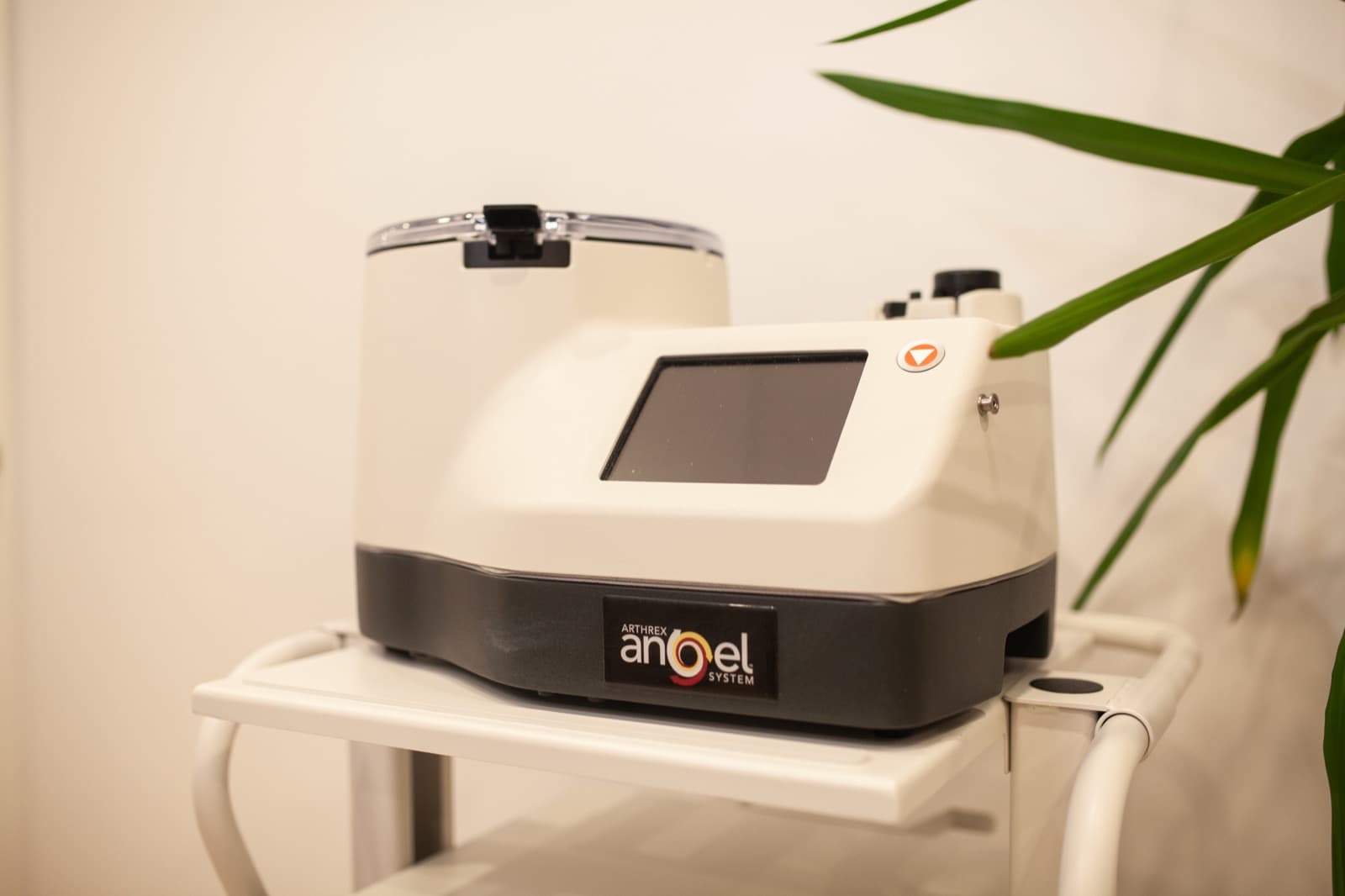
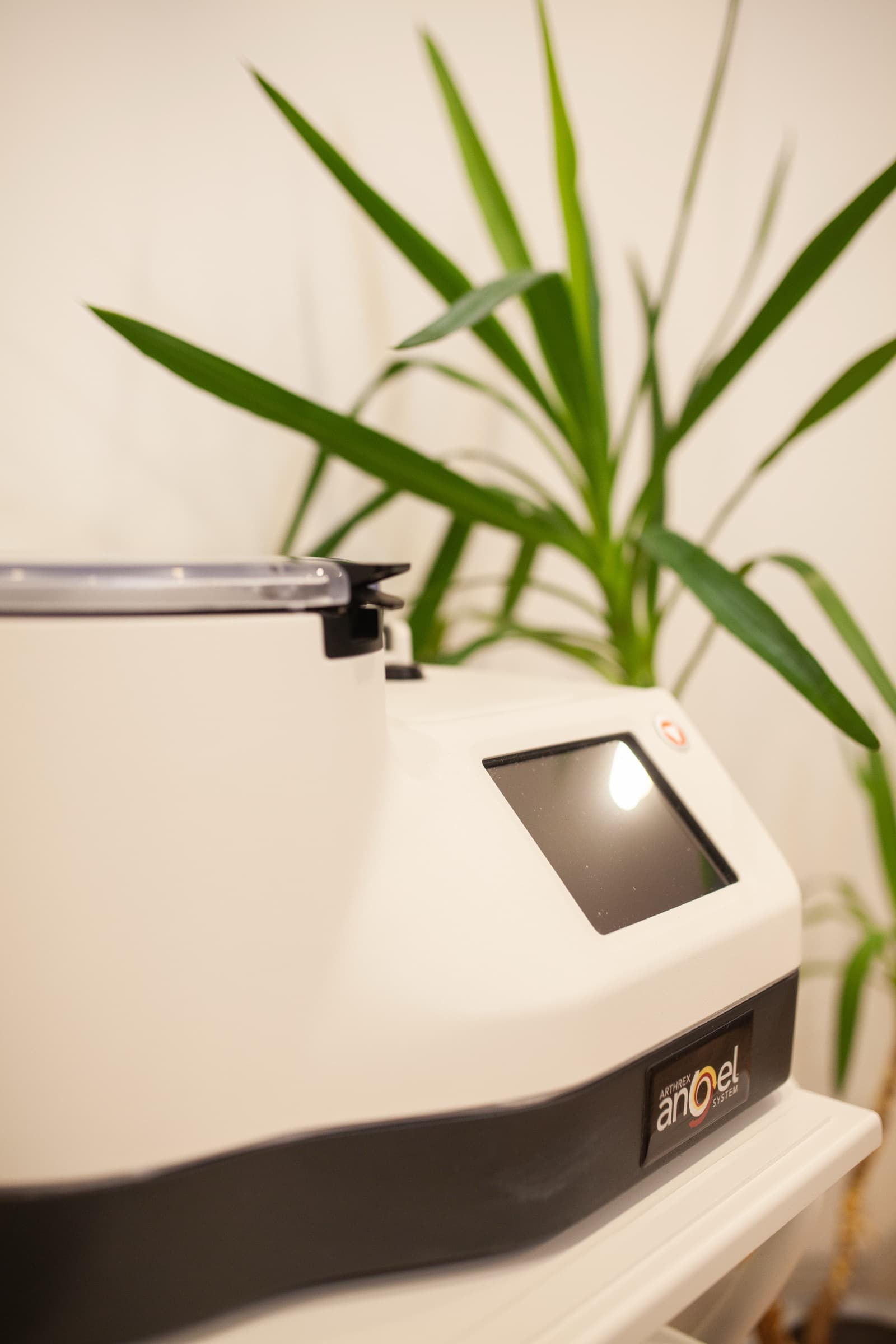
A small blood sample is drawn and processed in our Arthrex Angel system to isolate concentrated platelet rich plasma.
Ultrasound-Guided Injection
PRP is delivered precisely to the affected rotator cuff tendon, bursa or subacromial space under live ultrasound — the standard of care for shoulder injection.
Recovery & Physiotherapy
Recovery time depends on PRP concentration. We coordinate with your physiotherapist for the best return-to-function — most patients need 1–3 sessions spaced 4–6 weeks apart.
More Regenerative Options
PRP, Exosomes & Other Treatments
This page focuses on PRP for shoulder pain. Learn more about our full PRP therapy programme, our Health Canada-approved autologous exosome therapy (MCT System) for a more potent regenerative response, or all of our pain treatment options in Oakville.
Related Conditions
Other conditions we treat with PRP
Patients with shoulder pain often have — or develop — overlapping problems. Here are the related pages worth reading next.
Frozen Shoulder Treatment
Adhesive capsulitis often co-presents with rotator cuff problems — different condition, often related context.
Read more →PRP for Tennis Elbow & Golfer's Elbow
Upper-extremity overuse rarely stops at the shoulder. Many shoulder patients also have elbow tendinopathy.
Read more →PRP for Knee Osteoarthritis
Bilateral joint osteoarthritis is common — shoulder OA frequently coexists with knee OA in active older adults.
Read more →Related Reading
From the Oakville Pain Clinic blog
Frozen Shoulder Treatment in Oakville: What Actually Works
If your shoulder is stiff AND painful, frozen shoulder may be playing a role. An evidence-based treatment hierarchy.
PRP vs Cortisone: Which Is Right for Your Joint or Tendon Pain?
Most shoulder patients are weighing PRP against cortisone injections. Here's how they actually compare.
How Long Until PRP Actually Works? A Realistic Recovery Timeline
Shoulder rotator cuff tissue heals slowly — here's what to realistically expect after your injection.
Frequently Asked Questions
Shoulder Pain & PRP — FAQ
Does PRP work for rotator cuff injuries?
+
PRP can be effective for rotator cuff tendinopathy and partial-thickness tears in patients who haven't had surgery. The evidence is best for non-surgical rotator cuff problems — particularly chronic tendinopathy that has not responded to several months of physiotherapy. The evidence is more mixed for PRP as a surgical adjunct (combined with rotator cuff repair surgery). Your physician will review your MRI carefully and only recommend PRP when the clinical picture supports it.
Can PRP fix a torn rotator cuff?
+
PRP works best for tendinopathy and partial-thickness rotator cuff tears, where the tendon is damaged but not completely torn through. For full-thickness rotator cuff tears, particularly large or retracted tears, PRP alone is unlikely to be sufficient and surgical repair is often the better choice. We assess each patient individually based on imaging.
Is PRP better than cortisone for the shoulder?
+
They work very differently. Cortisone gives quick anti-inflammatory pain relief but can weaken the tendon over time and the relief is temporary. PRP stimulates actual tendon healing — the relief takes longer to develop (2–6 weeks) but lasts much longer and addresses the underlying tissue damage rather than masking inflammation. Many patients turn to PRP after one or two cortisone injections have stopped working.
How long does PRP take to work for shoulder pain?
+
Most patients notice improvement within 4 to 8 weeks as the tendon healing progresses. Full benefit typically develops over 3 to 6 months. Tendon healing is slow — patience matters with PRP. Many patients continue to improve for up to a year after a treatment course.
Does it hurt? What's recovery like for a shoulder PRP injection?
+
The injection itself feels similar to a standard shoulder injection — most patients describe mild to moderate discomfort with local anesthetic to minimize pain. Recovery depends on the PRP concentration. Higher-concentration PRP produces a stronger healing response but more discomfort for up to 48 hours and a couple of weeks of activity restriction (no overhead lifting, sometimes a sling). Lower-concentration PRP usually means same-day return to most activities with mild soreness for 2–5 days. Your physician will recommend the right concentration at consultation.
Can I keep doing physiotherapy while having PRP?
+
Yes — and we encourage it. PRP works best alongside structured physiotherapy. We typically recommend a brief reduction in activity for the first 1–2 weeks after each injection to let the healing response take hold, then a return to physiotherapy. We're happy to coordinate directly with your physiotherapist.
Will PRP help me avoid rotator cuff surgery?
+
For many patients with tendinopathy or small partial tears, yes — PRP can meaningfully delay or eliminate the need for surgery. For larger or full-thickness tears, especially in younger and more active patients, surgery may still be the better long-term option. We give every patient an honest assessment.
How much does PRP for shoulder pain cost in Oakville?
+
PRP is a private-pay procedure not covered by OHIP. Cost varies based on the concentration selected and ultrasound guidance is included on all shoulder PRP. Many extended-health benefit plans cover a portion under regenerative medicine, sports medicine or specialist injection benefits. We provide detailed receipts for insurance.
Ready to Start?
Book a Shoulder Pain Consultation
No physician referral required. Self-refer today and our team contacts you within 24 hours to schedule your consultation.
Sources & References
The clinical evidence cited above is drawn from the following peer-reviewed studies and authoritative medical sources:
- 1.Hamid MSA, et al. Platelet-rich plasma for rotator cuff tendinopathy: A systematic review and meta-analysis. PLOS One, 2021.
- 2.Yuwarungsikul T, et al. PRP provides modest but durable functional benefit over corticosteroid for rotator cuff tendinopathy: A systematic review and meta-analysis of randomized controlled trials. Knee Surgery, Sports Traumatology, Arthroscopy, 2024.
- 3.American Academy of Orthopaedic Surgeons (AAOS) — Platelet-Rich Plasma (PRP). OrthoInfo.
- 4.Johns Hopkins Medicine — Platelet-Rich Plasma (PRP) Treatment.
The information on this page is for general educational purposes only and is not a substitute for personalized medical advice. Consult one of our physicians to discuss whether PRP therapy is right for your specific condition.
PRP for Shoulder Pain in Oakville — Serving the Halton Region & GTA
Oakville Pain Clinic offers ultrasound-guided platelet rich plasma (PRP) injections for chronic shoulder pain — including rotator cuff tendinopathy, partial-thickness rotator cuff tears, shoulder impingement, subacromial bursitis, biceps tendinopathy and calcific tendinitis. Our board-certified physicians treat patients who haven't responded to physiotherapy, who want to delay or avoid surgery, or whose cortisone shots have stopped helping.
We treat shoulder pain patients from across Oakville (Bronte, Glen Abbey, West Oak Trails, Joshua Creek, Iroquois Ridge, College Park, Old Oakville, Eastlake, Clearview), as well as Burlington, Mississauga, Milton, Hamilton, Halton Hills (Georgetown and Acton), Brampton, Etobicoke and Toronto. Our clinic is at Unit 7, 1400 Cornwall Road in Oakville, easily accessible from the QEW, 403 and 407.
If you're searching for PRP for rotator cuff Oakville, shoulder pain treatment near me, rotator cuff injury treatment, or non-surgical shoulder injections in the Halton Region, contact Oakville Pain Clinic at 647-910-5359 or self-refer online — our team will reach out within 24 hours.